

Facelift and neck lift surgery are among the most technically demanding procedures in plastic surgery. The face is a layered, intricate structure, and the margin between a result that looks natural and one that looks surgical often comes down to a single factor: how deeply your surgeon knows it.
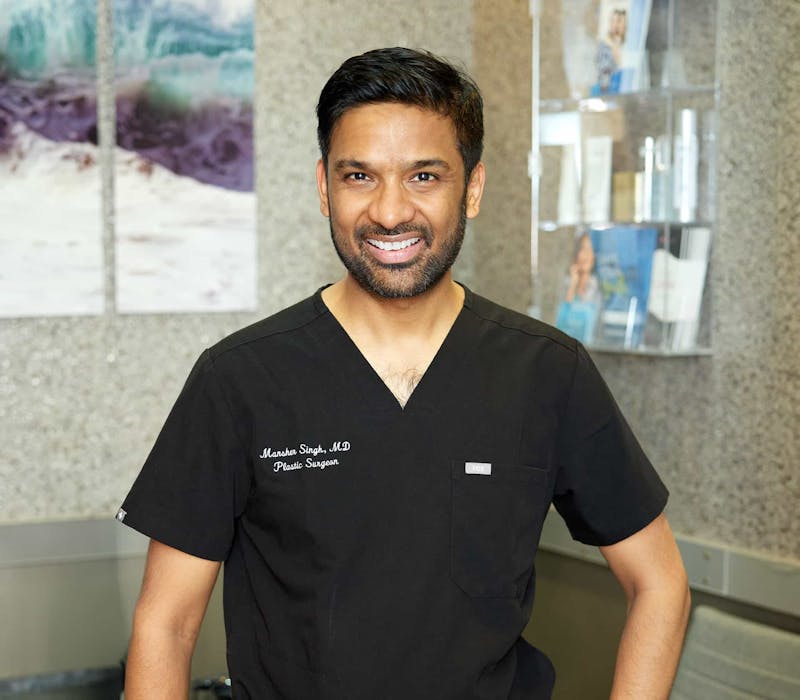
Dr. Mansher Singh, MD is one of fewer than ten facial plastic surgeons in the world to hold triple board certification from the American Board of Surgery, the American Board of Plastic Surgery, and the American Board of Facial Plastic & Reconstructive Surgery. Trained at Harvard Medical School and Johns Hopkins, he has built his practice around one discipline: the face. Read on to understand why that focus matters when choosing a surgeon for facelift or neck lift surgery.
What Facial Specialization Actually Means
General plastic surgery spans a wide scope, from breast reconstruction to body contouring to hand surgery. A surgeon who operates across all of these areas may perform facelifts competently. Facial specialization requires something more.
A facial specialist develops a working understanding of how the skin, fat, muscle, and fascia interact, age, and respond to surgery through years of focused, subspecialty training. That depth shows up in specific ways:
- Layered anatomy: The face has distinct tissue planes, including the superficial musculoaponeurotic system (SMAS) and the deeper fascial layers beneath it. Operating at these deeper levels produces more natural lift with less surface tension.
- Nerve preservation: The facial nerve fans into a complex network across the face. Precise anatomical knowledge is essential to avoid injury during dissection.
- Proportional judgment: Restoring youthful contour requires an aesthetic eye calibrated to facial balance, not just surgical execution.
- Technique selection: Advanced approaches like the deep plane facelift require dedicated fellowship training and high case volume to execute safely.
The Deep Plane Difference
Older facelift techniques addressed only the surface layer of skin. The deep plane facelift releases and repositions the underlying musculofascial tissues, correcting the structural changes that drive aging rather than masking them. Results tend to look more natural and last longer.
Dr. Singh performs the deep plane facelift as one of his signature procedures, including an "awake" approach using oral sedation that reduces anesthesia risk and supports faster recovery. Every case is planned around the individual patient's anatomy.
Why the Neck Lift Requires the Same Precision
The neck and lower face share anatomy. The platysma muscle, vertical banding, jawline contour, and jowls are part of one continuous structure. A neck lift planned without accounting for that relationship can correct the neck while leaving the jawline looking older, or create an imbalance that reads as surgical.
Dr. Singh addresses the full face-to-neck transition in a single, coordinated plan. For many patients, a facelift and neck lift are performed together for that reason.
What Sets Dr. Mansher Singh Apart
Fewer than ten surgeons worldwide hold triple board certification in Surgery, Plastic Surgery, and Facial Plastic & Reconstructive Surgery. For patients, that distinction reflects a career built entirely around the face. Combined with Dr. Singh's fellowship training under leading experts in facial plastic surgery, it is the foundation behind every result he delivers at his Park Avenue practice To schedule a consultation, contact Dr. Singh's team today.